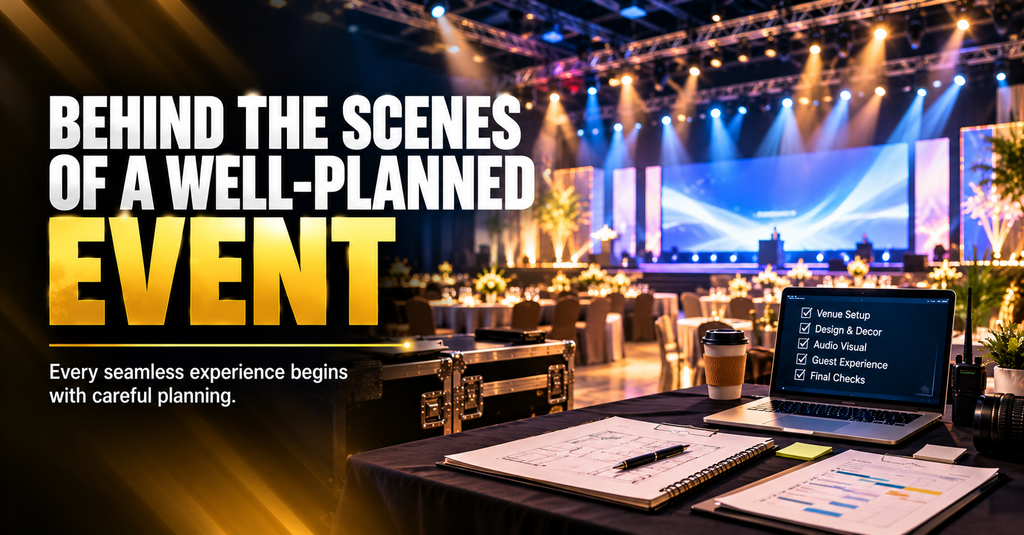
When an event goes well, it can look effortless.
Guests arrive without confusion. The programme starts on time. Speakers know when to step on stage. The lights come on at the right moment. The presentations run smoothly. Food is served when it should be. Everyone seems to know what they are doing.
For the people attending, it may feel simple.
But behind that simplicity is a lot of planning.
A successful event is rarely the result of luck. It is usually the result of countless conversations, decisions, rehearsals, checklists, adjustments, and people working together long before the first guest arrives.
It Starts With an Idea
Every event begins with a reason.
It could be a conference, an exhibition, a product launch, a corporate celebration, an awards evening, or a private gathering.
Before anything else, the purpose needs to be clear.
Who is the event for?
What should people take away from it?
What should they experience?
What does success look like?
These questions may sound simple, but they influence almost every decision that follows.
Good event planning starts with understanding the purpose rather than immediately jumping into the details.
For an experienced Event Management Company in Qatar, this first stage is about listening to the client, understanding the objective, and turning an initial idea into a clear direction.
Turning an Idea Into a Plan
Once the objective is clear, the idea needs to become something practical.
This is where the real planning begins.
The venue, date, budget, guest list, programme, production requirements, branding, catering, entertainment, transportation, staffing, and technical arrangements all need to be considered.
There is no single checklist that works for every event.
Each event has its own requirements, audience, challenges, and expectations.
A well-planned event brings these different pieces together and gives everyone involved a clear understanding of what needs to happen and when.
This is one of the areas where an experienced Event Planning Company can make a real difference, bringing creative ideas and practical execution together from the beginning.
Choosing the Right Venue
The venue is more than just a location.
It can influence the entire experience.
The size of the space, accessibility, parking, seating, stage possibilities, technical facilities, guest movement, catering arrangements, and overall atmosphere all matter.
A venue that looks perfect in photographs may not necessarily be right for the event.
The right choice comes from understanding what the event actually needs.
Experienced Event Organizers in Qatar consider these practical details while also thinking about how the venue will feel from a guest’s perspective.
The Experience Is Planned Too
Event planning isn’t only about logistics.
The guest experience needs to be considered from beginning to end.
What will guests see when they arrive?
How will they register?
Where will they go next?
Will they know where to sit?
How will the programme flow?
When will they have opportunities to interact and network?
Even small moments can influence how people feel about an event.
A good event feels natural because the journey has been carefully thought through beforehand.
The People Behind the Event
No event is delivered by one person.
There are usually many people working behind the scenes—event managers, designers, production teams, technicians, caterers, venue staff, hosts, photographers, security teams, transport teams, and many others.
Each team has a different responsibility.
The challenge is making sure everyone is working toward the same outcome.
Clear communication becomes essential.
One missed update can affect another team, which can then affect something else.
Strong coordination helps keep all these moving parts connected.
This is why choosing the right Best Event Management Company in Qatar should be about more than the appearance of previous events. The ability to coordinate people, timelines, suppliers, and unexpected situations is just as important.
Rehearsals Matter
A rehearsal may not look exciting, but it can prevent a lot of problems.
Speakers can understand where they need to stand.
The production team can check lighting and sound.
Presentations can be tested.
Video content can be reviewed.
Stage movements can be practised.
Timing can be checked.
These small preparations can make a huge difference when the real event begins.
The audience may never know a rehearsal took place and that’s exactly the point.
Technology Has to Work When It Matters
Modern events rely heavily on technology.
Screens, microphones, lighting, presentations, live streaming, registration systems, interactive displays, and other technical elements can all become part of the experience.
But technology can also create problems when it isn’t properly tested.
A presentation that won’t open, a microphone that stops working, or a video that doesn’t play at the right moment can quickly change the atmosphere.
This is why technical checks and backup plans are such an important part of event preparation.
Planning for the Unexpected
Even with the best preparation, not everything will go exactly as planned.
A speaker may arrive late.
A technical issue may appear.
Weather may change.
A guest may have a last-minute request.
A supplier may face an unexpected delay.
Good event planning doesn’t assume that nothing will go wrong.
It prepares for what might go wrong.
Having alternatives, backup contacts, additional time, and clear decision-making processes can help teams respond without allowing small problems to become major disruptions.
This ability to adapt is an important part of professional Event Management. Planning isn’t about controlling every possible situation; it’s about being prepared enough to respond when something changes.
The Final Hours Before the Doors Open
There is a particular kind of energy behind the scenes just before an event begins.
The venue is being checked.
Lights are being tested.
Staff are taking their positions.
Presentations are being loaded.
Guests are being briefed.
Final details are being reviewed.
There may be dozens of things happening at the same time.
This is where preparation really shows.
When the planning has been done properly, the team doesn’t have to start figuring things out at the last minute. They already know what needs to happen.
When Guests Arrive
Then the doors open.
The people who planned the event move quietly into the background.
Guests may never see the production team checking the schedule or the event manager confirming the next cue.
They simply experience the event.
And that is a sign of good execution.
The work behind the scenes should support the experience without becoming the experience.
Why Communication Matters
One of the most important parts of event planning is communication.
Everyone needs to know what is happening, who is responsible for it, and what happens next.
This becomes even more important when multiple vendors, teams, speakers, and partners are involved.
An experienced Event Management Company understands that communication is not something that happens only during meetings.
It continues throughout the planning process and becomes especially important on event day.
Experience Makes a Difference
Planning an event on paper and managing one in reality are two different things.
Experience helps teams understand what to look for, what questions to ask, and where problems are likely to appear.
Experienced Event Organizers have often seen situations that cannot be predicted by a checklist alone.
They know when something needs more preparation, when a schedule needs flexibility, and when a small detail could become a bigger issue later.
That experience can make the difference between an event that simply works and one that feels genuinely seamless.
What Guests Remember
Guests may never know how many hours were spent preparing the event.
They may not see the supplier meetings, technical checks, rehearsals, spreadsheets, phone calls, or last-minute decisions.
But they experience the result.
They remember whether they felt welcomed.
Whether the event was easy to navigate.
Whether the programme kept their attention.
Whether the atmosphere felt right.
Whether everything seemed to happen naturally.
That’s the real value of the work behind the scenes.
Good Planning Makes Events Feel Simple
The irony of a well-planned event is that the planning itself is often invisible.
When everything works, people don’t think about why it worked.
They simply enjoy the experience.
That’s why the goal of event planning isn’t to make the process look complicated.
It’s to make the final experience feel simple.
For organizations working with the Best Events Company in Qatar, this behind-the-scenes coordination can be particularly important when an event involves multiple teams, large audiences, technical production, or tight timelines.
A well-planned event is built long before the first guest walks through the door.
It starts with an idea, develops through careful planning, comes together through teamwork, and is strengthened by preparation for the unexpected.
The audience may only see a few hours of the final experience.
Behind those hours are days or months of work.
That’s what makes a successful event feel effortless.
Whether it’s a conference, exhibition, product launch, or corporate gathering, the right Event Management Company in Qatar brings together planning, creativity, coordination, and execution to create an experience that feels natural to the people attending.