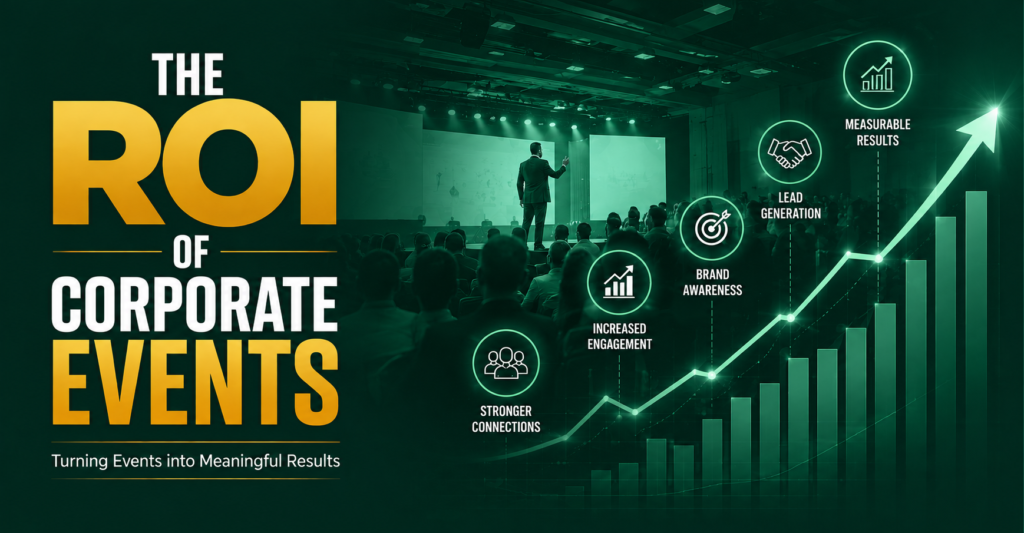
When businesses plan a corporate event, one of the first questions that often comes up is: “What will we get in return?”
It’s a fair question.
Corporate events require time, planning, people, and investment. Whether it’s a conference, product launch, exhibition, networking event, team gathering, or awards ceremony, businesses want to know whether the event is actually contributing to their goals.
The value of a corporate event, however, isn’t always measured by immediate sales.
Sometimes, the real return comes from stronger relationships, better brand visibility, new business opportunities, employee engagement, or meaningful connections that continue long after the event is over.
That’s what makes the ROI of corporate events much more than a simple financial calculation.
What Does ROI Really Mean for a Corporate Event?
Return on investment doesn’t necessarily mean looking only at revenue generated during the event.
A successful corporate event can create value in many different ways.
It might introduce a company to potential customers, strengthen relationships with existing clients, generate new leads, improve employee morale, increase brand awareness, or position a business as a leader within its industry.
The key is to define what success looks like before the event begins.
When the objectives are clear, it becomes much easier to plan the event around measurable outcomes.
Building Stronger Client Relationships
Business relationships are built on more than emails, meetings, and phone calls.
Face-to-face interactions create opportunities for genuine conversations and stronger connections. A well-planned corporate event gives businesses a chance to meet clients in a more engaging environment, understand their needs, and build trust.
A conference, networking dinner, product demonstration, or private corporate gathering can create valuable interactions that may eventually lead to long-term partnerships and business opportunities.
In many cases, the relationship created at an event can be more valuable than the immediate return.
Generating New Leads and Business Opportunities
Corporate events can also become powerful platforms for generating new business.
Exhibitions, conferences, product launches, and networking events bring together people who may already have an interest in a particular industry, product, or service.
With the right strategy, every interaction can become an opportunity.
From collecting registrations and contact details to arranging demonstrations and follow-up meetings, event planning can be designed around the company’s lead-generation goals.
However, generating leads is only the beginning. Following up with those connections after the event is what turns opportunities into measurable results.
Strengthening Employee Engagement
Not every corporate event is focused on customers.
Internal events can deliver significant value by bringing employees together, recognizing achievements, improving communication, and strengthening company culture.
Team-building activities, annual celebrations, leadership events, and employee recognition programs can help people feel more connected to the organization.
When employees feel valued and engaged, the benefits can extend beyond the event itself.
A positive employee experience can influence motivation, collaboration, and workplace culture over time.
Increasing Brand Visibility
A corporate event is also an opportunity to showcase what a company stands for.
From the venue design and stage setup to presentations, branding, entertainment, and guest experiences, every element contributes to how attendees perceive the organization.
A professionally executed event can create memorable brand experiences that attendees are likely to share with colleagues, business partners, and their wider networks.
This makes corporate events a valuable part of a broader brand-building strategy.
Creating Valuable Networking Opportunities
One of the biggest benefits of corporate events is the opportunity to bring the right people into the same room.
Industry professionals, potential clients, partners, investors, employees, and decision-makers can interact in ways that may not happen through traditional business communication.
Sometimes, a single conversation can lead to a partnership, referral, new client, or future business opportunity.
That’s why successful Event Organizers focus not only on logistics but also on creating an environment where meaningful conversations can happen naturally.
Measuring the Success of an Event
If businesses want to understand their event ROI, measurement needs to begin before the event takes place.
Depending on the purpose of the event, businesses can track metrics such as:
Number of registrations and attendees
Qualified leads generated
New business opportunities
Client or partner meetings
Social media engagement
Website traffic
Brand mentions
Customer feedback
Employee participation and engagement
Post-event conversions
The right metrics depend on the objective.
For example, a product launch may focus on leads and sales, while an employee event may focus more on participation, satisfaction, and engagement.
The Role of Professional Event Planning
A successful corporate event doesn’t happen simply because people attend it.
Every stage—from the initial concept and budgeting to venue selection, production, guest management, technology, and post-event evaluation—can influence the final outcome.
This is where an experienced Event Management Company can make a significant difference.
Professional planners don’t just organize the visible elements of an event. They help businesses align the event with its objectives, manage resources effectively, anticipate challenges, and create an experience that delivers value.
For organizations planning high-profile corporate events, working with the Best Event Management Company can provide the expertise and coordination needed to turn an investment into a meaningful business opportunity.
ROI Starts Before the Event
One of the biggest mistakes businesses can make is thinking about ROI only after the event is over.
The foundation for measuring success should be established during the planning stage.
What is the purpose of the event?
Who should attend?
What action should attendees take afterward?
What results would make the event successful?
When these questions are answered early, the event can be designed with a clear direction.
This approach allows an Event Management Company to create an experience where creativity, logistics, technology, and business objectives work together.
The Long-Term Value of Corporate Events
Some of the most valuable results of an event may not appear immediately.
A conversation today could become a business partnership months later. A connection made during a networking session could lead to a new client. An employee who feels recognized may become more engaged with the organization.
This is why the ROI of corporate events should be viewed from both a short-term and long-term perspective.
The best Events Company understands that an event isn’t simply a one-day activity. It’s an opportunity to create relationships, experiences, and business value that continue well beyond the closing ceremony.
Corporate events should not be viewed simply as an expense on the business calendar.
When planned with a clear purpose, they can become powerful platforms for building relationships, generating opportunities, strengthening teams, increasing brand visibility, and achieving meaningful business objectives.
The real ROI of a corporate event isn’t always found in one number.
Sometimes, it’s in the client relationship that becomes a long-term partnership. Sometimes, it’s the lead that becomes a new customer. Sometimes, it’s the employee who leaves feeling valued. And sometimes, it’s the impression your brand leaves behind.
Great corporate events create value long after the guests have gone home. And when every decision is made with purpose, the investment becomes much more than the cost of hosting an event—it becomes an investment in people, relationships, and the future of the business.